




Adaptive SSO: Benefits, Limitations, and Where It Falls Short
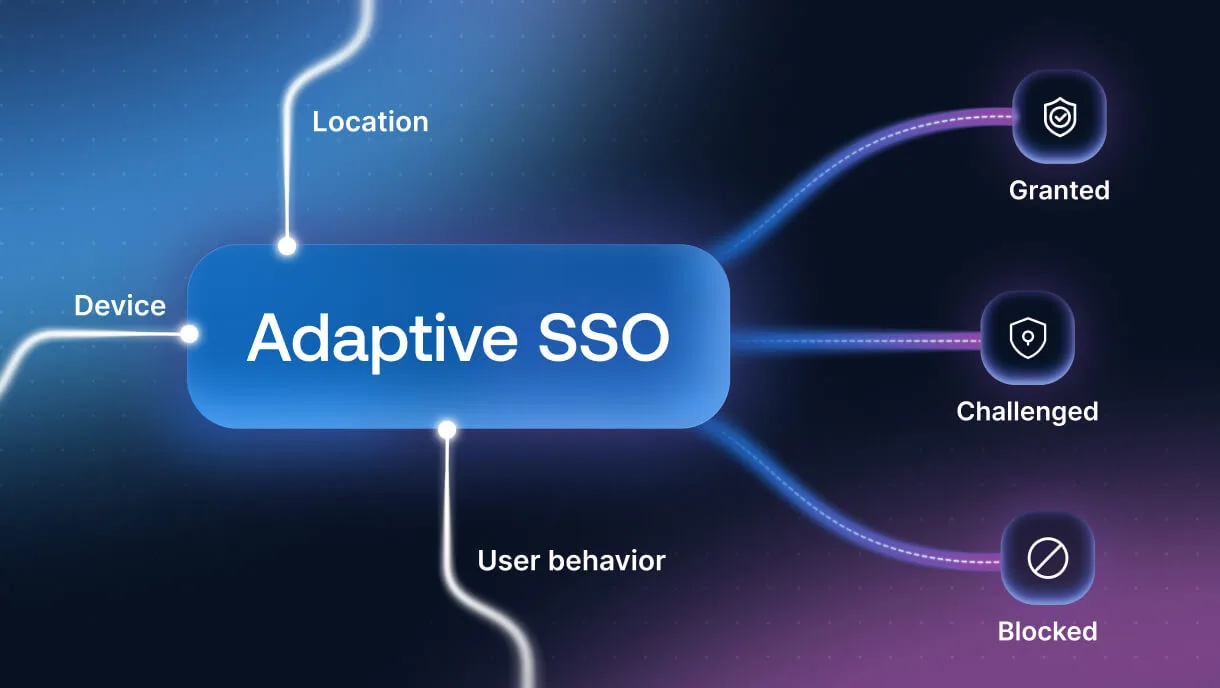
Adaptive SSO enhances traditional single sign-on by introducing contextual and risk-based decision-making into authentication workflows. Instead of relying on a one-time login, it evaluates factors such as device, location, and user behavior to determine whether access should be granted, challenged, or blocked. This approach improves access control while reducing unnecessary authentication friction. However, adaptive SSO still depends on assumptions about device trust and session continuity, which may not hold in environments with shared systems or dynamic user behavior.

Single Sign-On was built to reduce login friction. One identity, multiple applications, faster access. But in frontline environments where devices are shared, and users rotate frequently, that model breaks down. On a shared workstation, multiple users access the same system across shifts. Sessions often persist, and identity is tied to the login event, not the actual person using the device at any given moment. When that single identity is compromised, the impact multiplies just as quickly. According to Microsoft, over 99.9% of account compromise attacks can be blocked with strong authentication methods, yet credential-based attacks continue to rise due to gaps after login.
Adaptive SSO is an extension of traditional SSO that continuously evaluates access risk using signals such as device context, location, and user behavior, and dynamically adjusts authentication requirements during login.
It improves how access decisions are made at the point of authentication. But in environments with shared devices and shifting users, risk does not stop at login. Identity can change mid-session, while the system continues to trust the original authentication.
What is Adaptive SSO Authentication
Adaptive SSO combines single sign-on with contextual authentication. It allows users to access multiple applications through one login while dynamically adjusting authentication requirements based on risk.
Adaptive SSO evaluates signals such as device, location, time, and behavior. Based on these inputs, it determines whether to allow access, require additional verification, or block the attempt. While traditional SSO relies on a one-time login and assumes continued trust. Adaptive SSO introduces dynamic decision-making, aligning with modern Zero Trust Architecture and evolving Identity and Access Management practices.
Why Traditional SSO Authentication Models No Longer Work
Static login limitations
Traditional systems rely on fixed credentials. Once verified, access is granted without considering the changing context.
One-time authentication problem
A single successful login often unlocks multiple applications. This creates a dependency on session trust rather than continuous validation.
Expanding attack surface
Cloud adoption, remote work, and distributed systems have increased entry points. A compromised login can now lead to widespread access.
In operational environments, this risk is amplified when multiple users rely on the same system throughout the day. Adaptive SSO attempts to address these issues by introducing context-aware decision-making.
Key Benefits of Adaptive SSO and Risk-Based Authentication
Context-aware security
Adaptive SSO strengthens security by evaluating authentication attempts in real time. It detects anomalies, flags suspicious activity, and adjusts access decisions dynamically based on risk This allows organizations to respond to evolving security threats and vulnerabilities without relying solely on static controls.
Reduced MFA fatigue
Traditional MFA often applies the same authentication factors for every login. Adaptive SSO introduces intelligence into this process by triggering additional verification only when risk increases. This reduces unnecessary prompts while maintaining a strong defense against unauthorized access.
Smarter access control
Access control becomes more precise and context-driven. Instead of applying uniform policies, adaptive SSO adjusts decisions based on user behavior, device trust, and environmental signals. This improves both security and operational efficiency.
Improved user experience
By minimizing interruptions for low-risk scenarios, adaptive SSO enables seamless access to systems and applications. Users can access critical tools without repeated authentication steps, which improves workflow continuity, especially in time-sensitive environments.
Compliance and audit readiness
Adaptive SSO generates detailed access logs that capture contextual data such as device, location, and behavior. These logs support compliance requirements and integrate with security platforms like SIEM systems, helping organizations maintain visibility and audit readiness across their identity and access management infrastructure.
Limitations of Adaptive SSO Authentication in Real
Assumes device equals user
Adaptive SSO often relies on device trust as a primary signal. If a device is recognized, access is more likely to be granted. This assumption breaks in shared device access scenarios where multiple users access the same system across shifts.
Session persistence issues
Once a user is authenticated, the session often continues without re-validation. If another user takes over the device, the system may still treat the session as trusted. This creates a gap between authentication and actual identity.
In shared environments, identity is not static. It changes as users rotate across the same system. OLOID is designed specifically for environments where identity changes continuously, shared devices, shift-based workflows, and frontline operations.
Over-reliance on risk signals
Signals such as IP address, location, and device fingerprint are indicators of behavior, not proof of identity. An attacker using stolen credentials from a familiar environment may not trigger high-risk signals, allowing access to continue undetected.
MFA fatigue still exists
Even with adaptive triggers, users may approve MFA prompts without fully verifying the request. This weakens the effectiveness of multi-factor authentication as a security control.
Complexity in tuning and implementation
Adaptive SSO requires continuous tuning to balance security and user experience. Poor configuration can either increase friction or leave gaps in defense, making it difficult for security teams to maintain optimal performance.
How Risk-Based Authentication Works in Adaptive SSO
Adaptive SSO relies on risk-based authentication to evaluate whether a login attempt should be trusted. Instead of treating every login the same, it performs a real-time risk assessment using multiple contextual signals.
Risk signals (device, location, behavior)
Adaptive SSO evaluates:
- device fingerprint and recognition
- IP address and geographic patterns
- behavioral signals such as typing patterns or access timing
These signals are used to establish a behavioral baseline for legitimate users.
Over time, systems learn what normal access looks like. When a login deviates from this baseline, it is flagged as an anomaly.
Risk scoring
Each signal contributes to an overall risk level.
- familiar device + expected behavior → low-risk
- unusual location or access pattern → medium-risk
- unknown device + suspicious activity → high-risk
This scoring allows security teams to assess risk dynamically instead of relying on static rules.
Decision flow (allow/challenge/block)
Based on the calculated risk level:
- low-risk → seamless access is granted
- medium-risk → additional verification, such as multi-factor authentication, is triggered
- high-risk → access is blocked to prevent unauthorized access
This dynamic model improves security posture while reducing unnecessary friction for legitimate users.
Where Adaptive SSO Works Well
Personal devices
Adaptive SSO performs well when devices are tied to individual users.
Remote workforce
Employees using managed devices benefit from smoother access and improved control.
Low device-sharing environments
Stable user-device relationships improve signal reliability.
Where Adaptive SSO Falls Short
Adaptive SSO performs well when there is a stable relationship between user, device, and session.
In operational environments, that relationship does not exist.
Shared devices
In healthcare, manufacturing, and retail, devices are shared across multiple users. Adaptive SSO cannot reliably distinguish between individuals once access has been granted. The system continues to trust the session rather than verifying the current user.
In these environments, identity needs to be tied to the person interacting with the system in real time, not the login that happened minutes or hours earlier. This is where platforms like OLOID take a different approach, aligning authentication with physical presence and user interaction rather than with session continuity.
Shift-based environments
Frequent user transitions create identity gaps.
One user logs in, another continues using the same system, and the platform has no mechanism to detect the change in real time.
High user turnover scenarios
Environments with frequent onboarding and offboarding increase exposure to credential misuse. Without continuous verification, systems rely on outdated trust signals.
These limitations highlight a critical issue.
Adaptive SSO improves how login decisions are made, but it does not fully address how identity behaves during real-world usage.
The Gap Between Login and Identity
Login ≠ identity
Adaptive SSO verifies credentials at login, but it does not continuously confirm who is using the system.
Identity changes after authentication
In shared environments, one user may log in, and another may continue using the same session.
Why current systems miss this
Most systems are designed around login events, not continuous identity validation. They assume a stable relationship between user, device, and session.
This assumption breaks in real-world environments where access is fluid.
Authentication solutions such as OLOID are designed around this gap. Instead of extending trust from the moment of login, they focus on maintaining a live connection between identity and the person actively using the system, enabling continuous verification in environments where users, devices, and context are constantly changing.
What Needs to Change
Continuous identity validation
Authentication needs to extend beyond login. Systems should verify identity throughout the session.
Beyond session-based trust
Trust should adapt as conditions change, not remain fixed after authentication.
Toward presence-aware authentication
Future approaches will focus on confirming who is physically present and actively using the system, rather than relying only on credentials and context signals.
This becomes critical in environments with shared systems and dynamic workflows, where identity cannot be assumed.
Conclusion
Adaptive SSO is a meaningful improvement over traditional authentication. It introduces context into access decisions and reduces unnecessary friction. But it is not a complete solution.
It still depends on assumptions about users, devices, and sessions that do not always hold in real-world environments. The next phase of identity security will move beyond login-based trust toward continuous identity validation.
Because securing access is not just about who logs in. It is about knowing who is actually using the system at any given moment.

Get the latest updates! Subscribe now!

